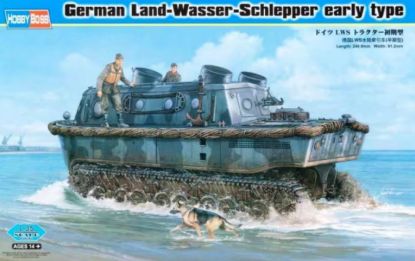
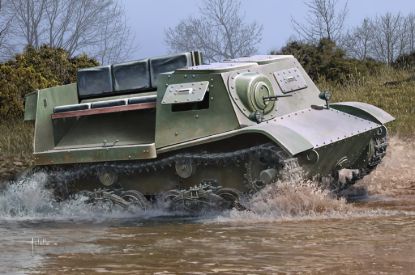
The Land-Wasser-Schlepper (LWS) was an unarmed amphibious tractor designed and manufactured in Germany during World War II. It was intended to assist German Army engineers with river crossings, bridging operations, and especially for potential amphibious landings, such as the planned invasion of Britain (Operation Sea Lion).
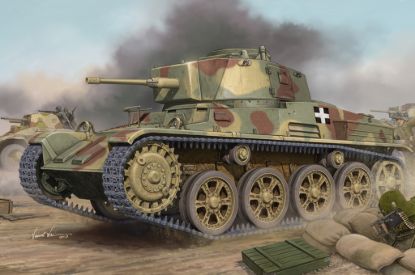
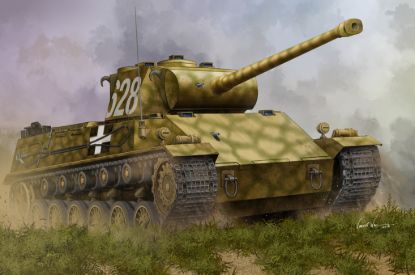
The Toldi was a Hungarian light tank of World War II, developed on the basis of the Swedish Landsverk L-60. It was named after the 14th century Hungarian knight Miklós Toldi. The Toldi was made in several different variants including some armed with a 20 mm gun, some armed with a 40 mm gun, some fitted with schürzen plates, and even a prototype tank destroyer variant armed with a 75 mm gun. At least one was even fitted with heavy anti-tank rocket launchers.
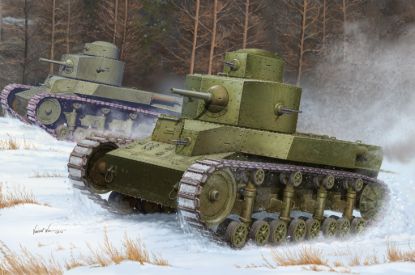
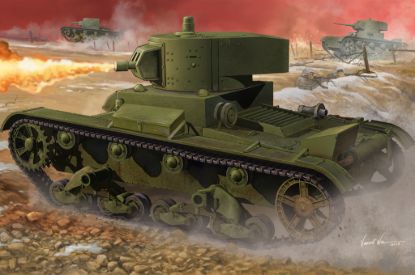
KhT-130 (OT-130) Flamethrower tank was a variant of the T-26 light infantry tank model 1933, using a larger 45 mm gun turret (main gun was replaced with a flamethrower).
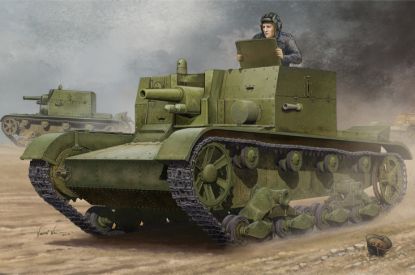
The AT-1 is a Soviet self-propelled gun prototype developed in the 1930s, based on the T-26 light tank chassis, featuring a 76.2 mm gun and designed for artillery support.
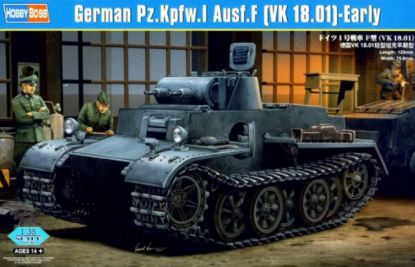
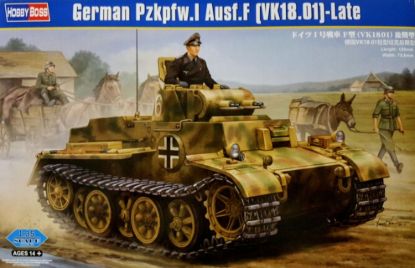
The Panzer I Ausf. F, was as different from the Ausf. C as it was from the Ausf. A and B.[28] Intended as an infantry support tank, the Panzer I Ausf. F had a maximum armor thickness of 80 millimeters (3.15 in) and weighed between 18 and 21 tonnes.[29] The Ausf. F was armed with two 7.92 mm MG-34s.[30] Thirty were produced in 1940, and a second order of 100 was later canceled. In order to compensate for the increased weight, a new 150 horsepower (110 kW) Maybach HL45 Otto engine was used, allowing a maximum road speed of 25 kilometers per hour (15.5 mph) and used five overlapping road wheels per side, dropping the Ausf. C's interleaved units.
The Panzer I Ausf. F, was as different from the Ausf. C as it was from the Ausf. A and B.[28] Intended as an infantry support tank, the Panzer I Ausf. F had a maximum armor thickness of 80 millimeters (3.15 in) and weighed between 18 and 21 tonnes.[29] The Ausf. F was armed with two 7.92 mm MG-34s.[30] Thirty were produced in 1940, and a second order of 100 was later canceled. In order to compensate for the increased weight, a new 150 horsepower (110 kW) Maybach HL45 Otto engine was used, allowing a maximum road speed of 25 kilometers per hour (15.5 mph) and used five overlapping road wheels per side, dropping the Ausf. C's interleaved units.
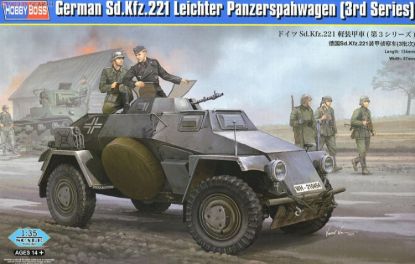
The Leichter Panzerspähwagen (Sd.Kfz. 221) was the first in a series of light reconnaissance vehicles designed to meet operational requirements including reliability, an ability to run on a variety of grades of fuel, simple construction and good off-road performance.
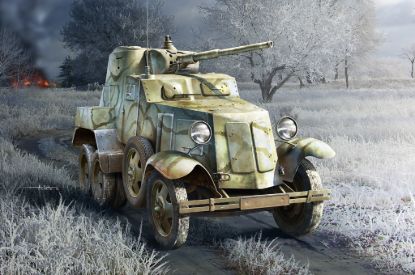
The BA-10 (Russian: Broneavtomobil 10) was an armored car developed in the Soviet Union in 1938 and produced through 1941. It was the most produced Soviet pre-1941 heavy armored car – 3311 were built in three versions. These versions were the BA-10, the BA-10M (improved version with new radio), and the BA-10ZhD (equipped for dual railway/road use).
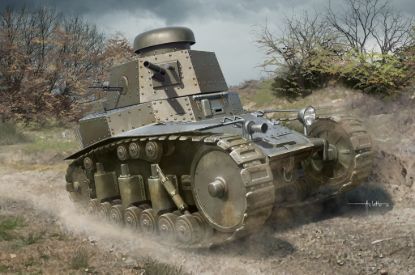
The T-18 light tank (also called MS-1) was the first Soviet-designed tank. Produced from 1928 to 1931, it was based on the Renault FT, with the addition of a vertically sprung suspension.
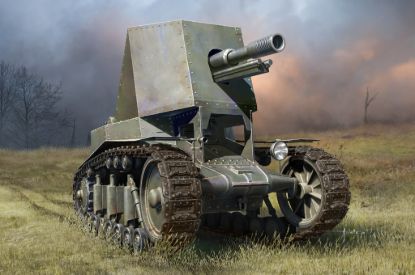
The SU-18 SPH is a Soviet self-propelled gun that was based on the T-18 chassis and used a 76.2-mm regimental gun model 1927. The design was based on a captured French Renault FT-17BS, but it replaced the turret with a truncated pyramid shape. The SU-18 had an ammunition capacity of 4-6 rounds and was known for its relatively slow speed and short range.
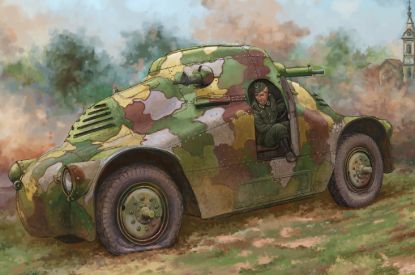
The Skoda PA-II Turtle Armored Car, also known as the "Zelva" (Turtle), was a Czech-designed armored vehicle that saw limited military use during World War II. Developed by Škoda, the PA-II was based on the earlier PA-I design but featured a new streamlined armored body.
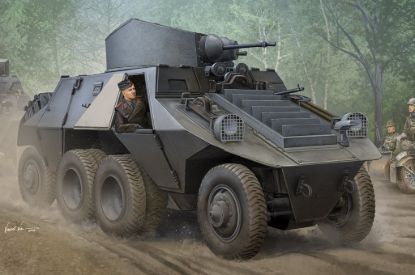
The ADGZ had 12 wheels, 4 axles, four headlights (two on each end), 6mm thick armor on the front, rear, and sides, and a dual transmission which allowed for the car to be driven from either end. The circular central turret housed a 20mm KwK 35 L/45 autocannon. Both sides were fitted with two half-doors where the top and bottom portions could be opened independently, as well as a ball mount on each side for an MG 34 machine gun.