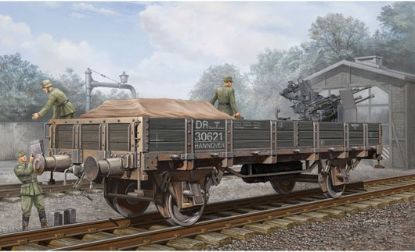
The military history of the German Railway Gondola is deeply intertwined with the Second World War, particularly during the German invasion of the Soviet Union.
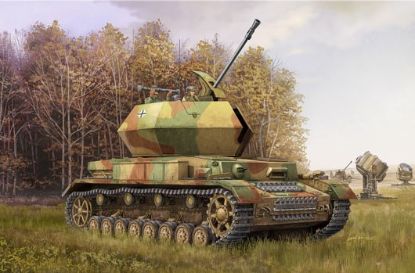
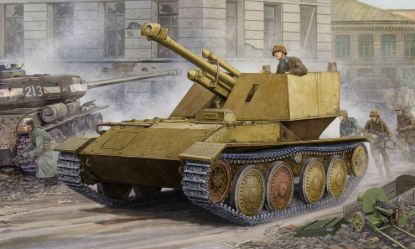
The Flakpanzer IV "Ostwind" was a significant development in the German military's efforts to counter the increasing air threat during World War II. Its primary role was as an anti-aircraft weapon, but it also provided protection against light vehicles and minor fortifications.
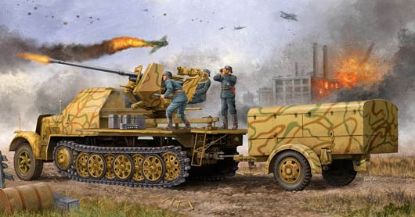
The Sd.Kfz. 7 was a half-track military vehicle used by the German Army, Luftwaffe and Waffen-SS during the Second World War. Sd.Kfz. is an abbreviation of the German word Sonderkraftfahrzeug, "special purpose vehicle". A longer designation is mittlerer Zugkraftwagen 8t, Sd.Kfz. 7, "medium towing motor vehicle 8t".
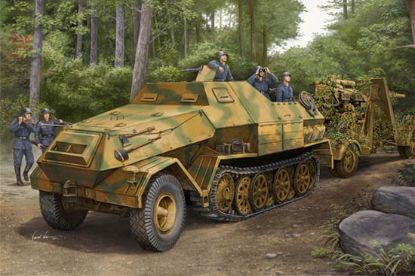
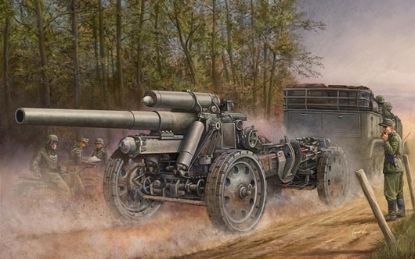
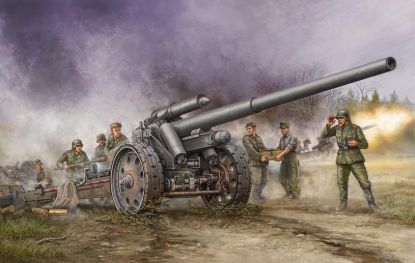
The Sonderkraftfahrzeug 8 ("special motorized vehicle 8"), usually abbreviated to Sd.Kfz. 8, was a German half-track designed by Daimler-Benz that saw widespread use in World War II. Its main roles were as a prime mover for heavy towed guns such as the 21 cm Mörser 18, the 17 cm Kanone 18 and the 10.5 cm FlaK 38. It also served as an infantry transport. Approximately 4,000 were produced between 1938 and 1945. It was used in every campaign fought by the Germans in World War II, notably the Invasion of Poland, the Battle of France, the Balkans Campaign, the Eastern Front, the North African Campaign, the Battle of Normandy and the Italian Campaign.
The Sonderkraftfahrzeug 8 ("special motorized vehicle 8"), usually abbreviated to Sd.Kfz. 8, was a German half-track designed by Daimler-Benz that saw widespread use in World War II. Its main roles were as a prime mover for heavy towed guns such as the 21 cm Mörser 18, the 17 cm Kanone 18 and the 10.5 cm FlaK 38. It also served as an infantry transport. Approximately 4,000 were produced between 1938 and 1945. It was used in every campaign fought by the Germans in World War II, notably the Invasion of Poland, the Battle of France, the Balkans Campaign, the Eastern Front, the North African Campaign, the Battle of Normandy and the Italian Campaign.
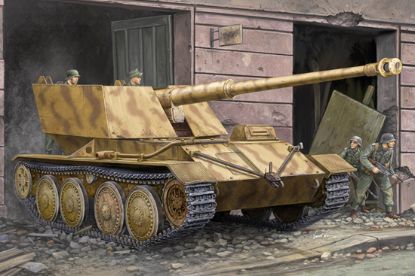
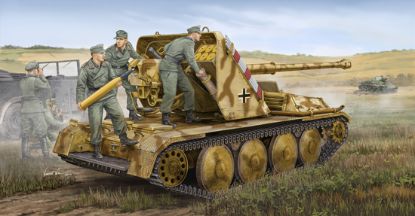
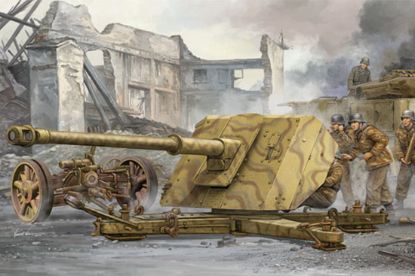
The German Waffentrager (weapon carrier), was formulated by the artillery and technical supply department at the end of 1942. It was assumed that two main types of carriers would be developed in parallel. The first one could be considered light and was supposed to mount a 75 mm PaK 40L/70 anti-tank gun, a 105 mm FH 18/40 howitzer, or a 37 mm FlaK anti-aircraft gun. The second type of carrier was intended for the more powerful 88 mm PaK 43 L/71 gun, the 150 mm FH 43 howitzer, and the 128 mm K43 gun.
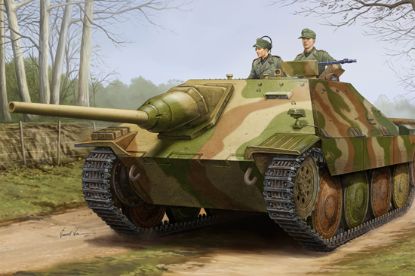
The Jagdpanzer 38 (Sd.Kfz. 138/2), originally the Leichter Panzerjäger 38(t), known mostly post-war as Hetzer, was a German light tank destroyer of the Second World War based on a modified Czechoslovak Panzer 38(t) chassis.
The German Waffentrager (weapon carrier), was formulated by the artillery and technical supply department at the end of 1942. It was assumed that two main types of carriers would be developed in parallel. The first one could be considered light and was supposed to mount a 75 mm PaK 40L/70 anti-tank gun, a 105 mm FH 18/40 howitzer, or a 37 mm FlaK anti-aircraft gun. The second type of carrier was intended for the more powerful 88 mm PaK 43 L/71 gun, the 150 mm FH 43 howitzer, and the 128 mm K43 gun.
The Sd.Kfz. 7 was a half-track military vehicle used by the German Army, Luftwaffe and Waffen-SS during the Second World War. Sd.Kfz. is an abbreviation of the German word Sonderkraftfahrzeug, "special purpose vehicle". A longer designation is mittlerer Zugkraftwagen 8t, Sd.Kfz. 7, "medium towing motor vehicle 8t".
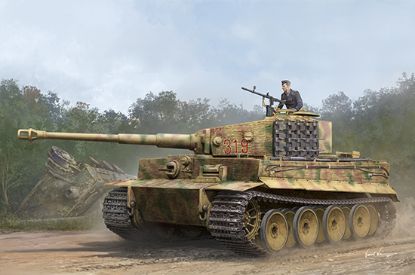
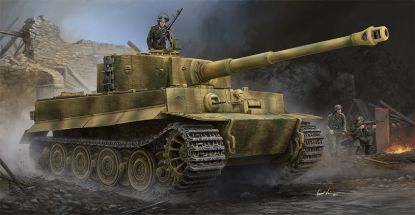
From the early days of combat against this tank in WW2 until the present day, the fame of the Tiger spans, in equal amounts, its real development history, combat performance, and fandom. It is a tank with many flaws and one whose mystique, even back in WW2, was out of all proportion to its utility and service as a combat vehicle. Yet, despite its flaws and problems, the tank remains a potent symbol of WW2 and, for many, it is the tank which served as their introduction to the world of armored fighting vehicles.
From the early days of combat against this tank in WW2 until the present day, the fame of the Tiger spans, in equal amounts, its real development history, combat performance, and fandom. It is a tank with many flaws and one whose mystique, even back in WW2, was out of all proportion to its utility and service as a combat vehicle. Yet, despite its flaws and problems, the tank remains a potent symbol of WW2 and, for many, it is the tank which served as their introduction to the world of armored fighting vehicles.
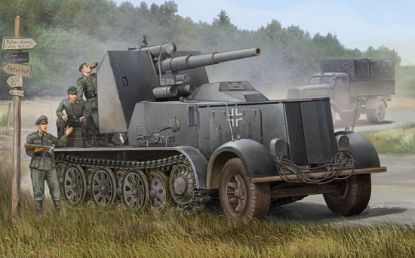
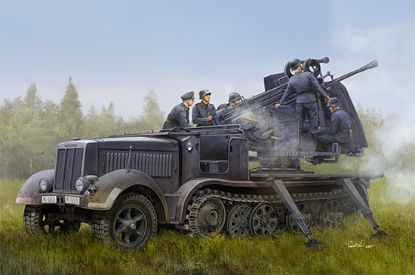
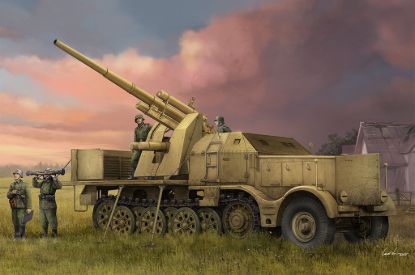
8.8 cm Flak 18 anti-aircraft guns were mounted on fifteen Sd.Kfz. 9s in 1940 as the 8.8 cm Flak 18 (Sfl.) auf Zugkraftwagen 18t (Sd.Kfz. 9) for anti-tank duties. The crew and engine compartments were lightly (14.5 mm (0.57 in)), but completely, armored, which limited the gun's ability to fire directly ahead. A platform with drop-down sides was fitted for the gun. Outriggers were necessary to brace the platform sides to support the weight of the gun crew.
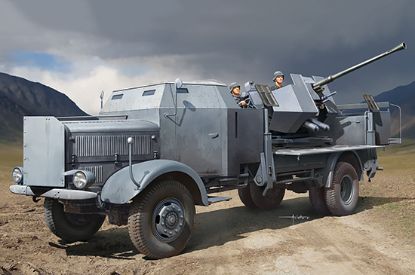
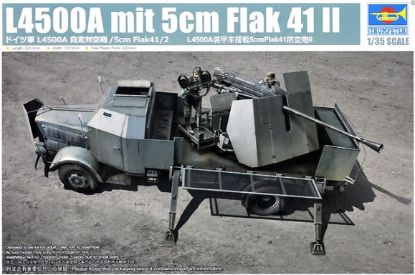
The Schwere Geländegängiger Lastkraftwagen 4.5t Mercedes-Benz L4500A als Flakwagen was a self-propelled anti-aircraft gun (SPAAG) used by the German military during World War II. It was built by converting a standard Mercedes-Benz L4500A heavy-duty truck into an anti-aircraft vehicle by mounting either a 2 cm, 3.7 cm, or even a 5 cm anti-aircraft gun on the truck’s bed.
The Schwere Geländegängiger Lastkraftwagen 4.5t Mercedes-Benz L4500A als Flakwagen was a self-propelled anti-aircraft gun (SPAAG) used by the German military during World War II. It was built by converting a standard Mercedes-Benz L4500A heavy-duty truck into an anti-aircraft vehicle by mounting either a 2 cm, 3.7 cm, or even a 5 cm anti-aircraft gun on the truck’s bed.