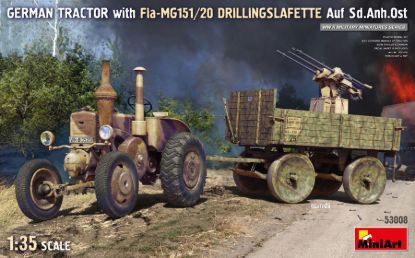
The Lanz Bulldog tractors played a significant role in military operations during World War I and World War II. They were used for carrying heavy artillery and other military equipment from railway stations to battlefields. During World War I, Lanz Bulldogs were also utilized for transporting heavy goods, including artillery and aircraft, by the German military.
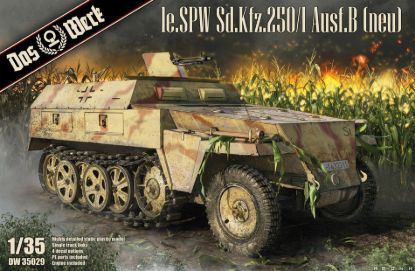
The Sd.Kfz. 250/1 was a versatile and crucial vehicle for the Wehrmacht during World War II. It served as an armored personnel carrier, typically carrying a small reconnaissance team of four to six soldiers. The vehicle's open-topped design and relatively light armor provided protection against small arms fire and shell splinters, while its half-track configuration offered excellent cross-country mobility.
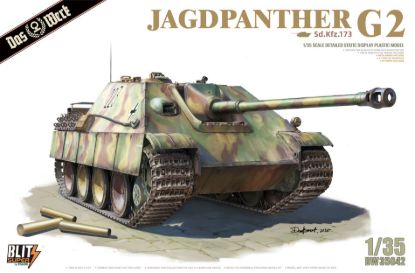
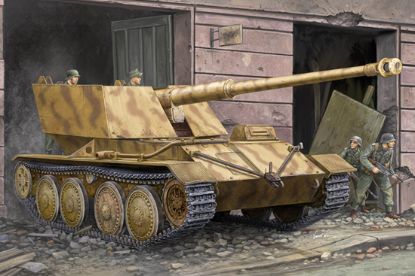
The Jagdpanther (German: "hunting Panther"), Sd.Kfz. 173, was a tank destroyer built by Germany during World War II. The Jagdpanther combined the 8.8 cm Pak 43 anti-tank gun, similar to the main gun of the Tiger II, with the armor and suspension of the Panther chassis.
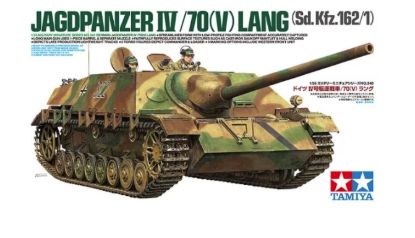
The Jagdpanzer IV / Sd.Kfz. 162, was a German tank destroyer based on the Panzer IV chassis and built in three main variants. As one of the casemate-style turretless Jagdpanzer (tank destroyer, literally "hunting tank") designs, it was developed against the wishes of Heinz Guderian, the inspector general of the Panzertruppen, as a replacement for the Sturmgeschütz III (StuG III). Guderian objected against the (in his eyes) needless diversion of resources from Panzer IV tank production, as the StuG III was still more than adequate for its role.
The German Waffentrager (weapon carrier), was formulated by the artillery and technical supply department at the end of 1942. It was assumed that two main types of carriers would be developed in parallel. The first one could be considered light and was supposed to mount a 75 mm PaK 40L/70 anti-tank gun, a 105 mm FH 18/40 howitzer, or a 37 mm FlaK anti-aircraft gun. The second type of carrier was intended for the more powerful 88 mm PaK 43 L/71 gun, the 150 mm FH 43 howitzer, and the 128 mm K43 gun.
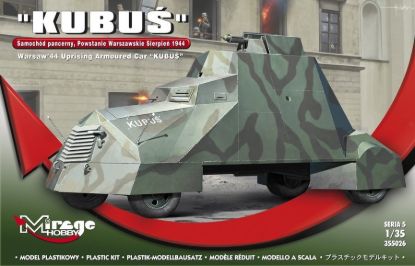
"Kubus" was built by the Polish Home Army during the Warsaw uprising of 1944. Only one vehicle was built and it took only about 13 days to complete. It was designed as an armored personnel carrier to be used during assaults.
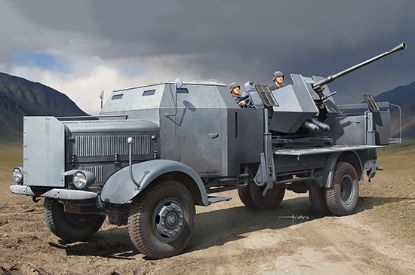
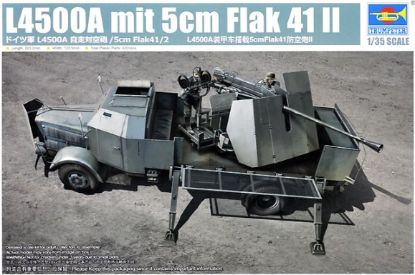
The Schwere Geländegängiger Lastkraftwagen 4.5t Mercedes-Benz L4500A als Flakwagen was a self-propelled anti-aircraft gun (SPAAG) used by the German military during World War II. It was built by converting a standard Mercedes-Benz L4500A heavy-duty truck into an anti-aircraft vehicle by mounting either a 2 cm, 3.7 cm, or even a 5 cm anti-aircraft gun on the truck’s bed.
The Schwere Geländegängiger Lastkraftwagen 4.5t Mercedes-Benz L4500A als Flakwagen was a self-propelled anti-aircraft gun (SPAAG) used by the German military during World War II. It was built by converting a standard Mercedes-Benz L4500A heavy-duty truck into an anti-aircraft vehicle by mounting either a 2 cm, 3.7 cm, or even a 5 cm anti-aircraft gun on the truck’s bed.
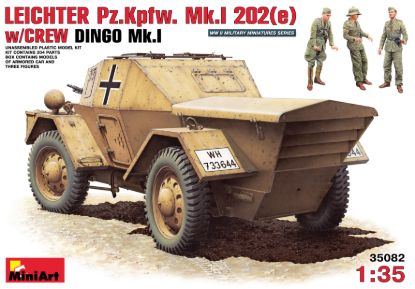
The Daimler Dingo, a variant of the Pz.Kmpf. Mk.I 202(e), was used by the Germans during the war, where it was transformed into the Pz.Kpfw.Mk.I 202. The Dingo's success in combat led to its continued use by various nations, including Cyprus, Portugal, and Sri Lanka, until the mid-1950s.
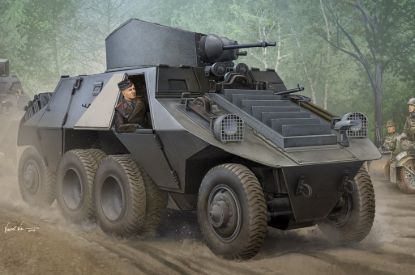
The ADGZ had 12 wheels, 4 axles, four headlights (two on each end), 6mm thick armor on the front, rear, and sides, and a dual transmission which allowed for the car to be driven from either end. The circular central turret housed a 20mm KwK 35 L/45 autocannon. Both sides were fitted with two half-doors where the top and bottom portions could be opened independently, as well as a ball mount on each side for an MG 34 machine gun.
The M3A1 Scout Car, also known as the White Scout Car, was an American armored car produced during World War II. It was used in various roles, including patrol, scouting, command vehicle, ambulance, and gun tractor.
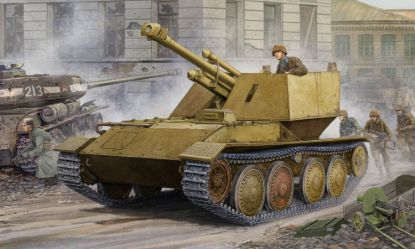
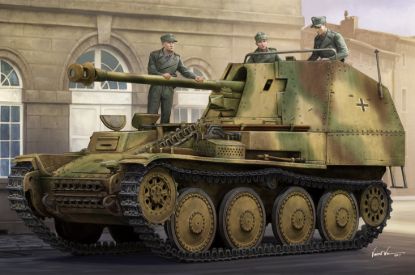
The Marder III, specifically, was equipped with the German 7.5 cm PaK 40 anti-tank gun, which was highly effective in penetrating the armor of most Allied tanks at standard engagement ranges. The Marder III served on all fronts until the end of the war, providing significant firepower to counter the thick-armored T-34s.