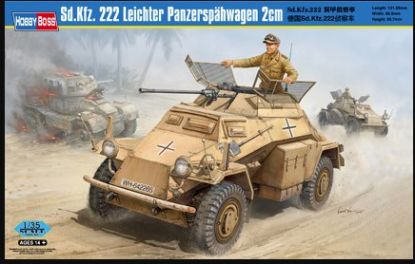
The Sd.Kfz. 222's development and deployment were marked by its success in early campaigns against unprepared opponents, but it faced significant vulnerabilities when confronting well-equipped Allied forces. The vehicle's armor-piercing vulnerability was discovered during tests, leading to its eventual replacement by the Sd.Kfz. 234 Puma. The Sd.Kfz. 222's history is a testament to the complexities of armored vehicle development and the impact of engineering compromises on battlefield performance.
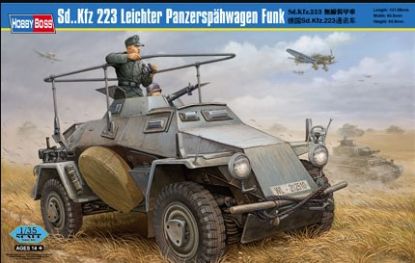
The Sd.Kfz. 223 was Command and Communications vehicle, distinguished by its large collapsible aerial antenna frame above the gun emplacement. It featured a crew of three, including a driver, commander, and machine gunner. The Sd.Kfz. 223 was produced in 567 units from 1936 to January 1944, benefiting from its dedicated armored chassis and Horch V8 gasoline engine for cross-country travel. The vehicle's design was closely related to the Sd.Kfz. 221, with a stepped rear upper hull section and a tapered hatch covering the engine compartment. The Sd.Kfz. 223 was used for reconnaissance and communications missions, with its light armor protection and 4x4 wheeled design providing it with the necessary strength for military service.
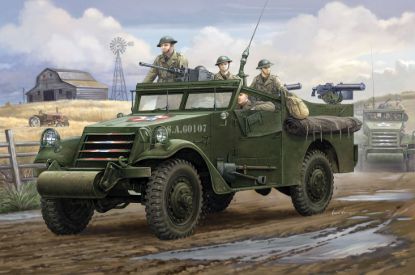
The M3A1 Scout Car, also known as the White Scout Car, was an American armored car produced during World War II. It was used in various roles, including patrol, scouting, command vehicle, ambulance, and gun tractor.
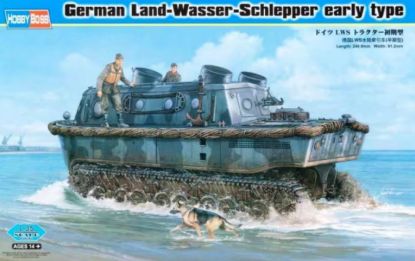
The Land-Wasser-Schlepper (LWS) was an unarmed amphibious tractor designed and manufactured in Germany during World War II. It was intended to assist German Army engineers with river crossings, bridging operations, and especially for potential amphibious landings, such as the planned invasion of Britain (Operation Sea Lion).
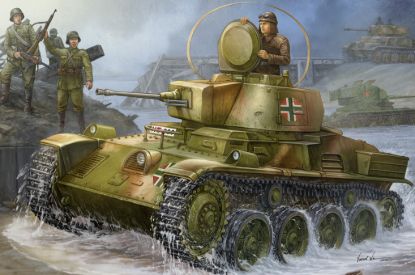
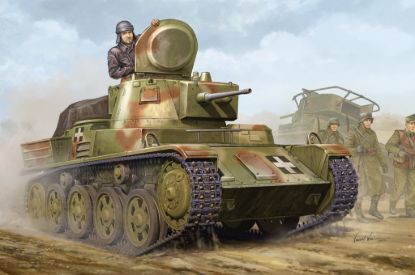
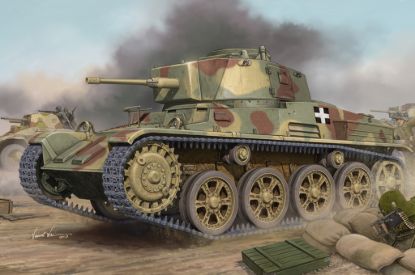
The Toldi was a Hungarian light tank of World War II, developed on the basis of the Swedish Landsverk L-60. It was named after the 14th century Hungarian knight Miklós Toldi. The Toldi was made in several different variants including some armed with a 20 mm gun, some armed with a 40 mm gun, some fitted with schürzen plates, and even a prototype tank destroyer variant armed with a 75 mm gun. At least one was even fitted with heavy anti-tank rocket launchers.
The Toldi was a Hungarian light tank of World War II, developed on the basis of the Swedish Landsverk L-60. It was named after the 14th century Hungarian knight Miklós Toldi. The Toldi was made in several different variants including some armed with a 20 mm gun, some armed with a 40 mm gun, some fitted with schürzen plates, and even a prototype tank destroyer variant armed with a 75 mm gun. At least one was even fitted with heavy anti-tank rocket launchers.
The Toldi was a Hungarian light tank of World War II, developed on the basis of the Swedish Landsverk L-60. It was named after the 14th century Hungarian knight Miklós Toldi. The Toldi was made in several different variants including some armed with a 20 mm gun, some armed with a 40 mm gun, some fitted with schürzen plates, and even a prototype tank destroyer variant armed with a 75 mm gun. At least one was even fitted with heavy anti-tank rocket launchers.
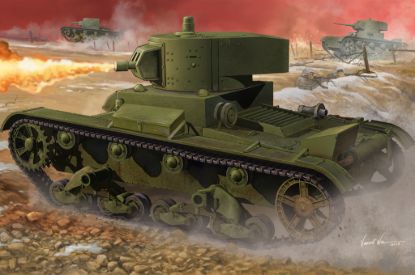
KhT-130 (OT-130) Flamethrower tank was a variant of the T-26 light infantry tank model 1933, using a larger 45 mm gun turret (main gun was replaced with a flamethrower).
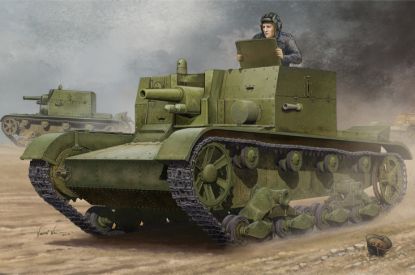
The AT-1 is a Soviet self-propelled gun prototype developed in the 1930s, based on the T-26 light tank chassis, featuring a 76.2 mm gun and designed for artillery support.
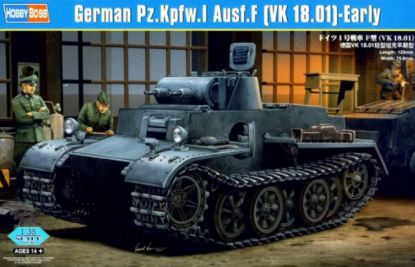
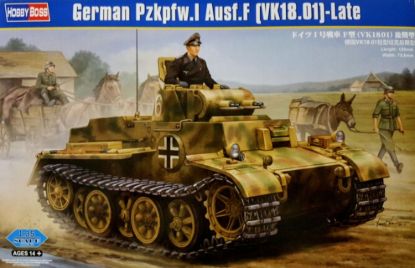
The Panzer I Ausf. F, was as different from the Ausf. C as it was from the Ausf. A and B.[28] Intended as an infantry support tank, the Panzer I Ausf. F had a maximum armor thickness of 80 millimeters (3.15 in) and weighed between 18 and 21 tonnes.[29] The Ausf. F was armed with two 7.92 mm MG-34s.[30] Thirty were produced in 1940, and a second order of 100 was later canceled. In order to compensate for the increased weight, a new 150 horsepower (110 kW) Maybach HL45 Otto engine was used, allowing a maximum road speed of 25 kilometers per hour (15.5 mph) and used five overlapping road wheels per side, dropping the Ausf. C's interleaved units.
The Panzer I Ausf. F, was as different from the Ausf. C as it was from the Ausf. A and B.[28] Intended as an infantry support tank, the Panzer I Ausf. F had a maximum armor thickness of 80 millimeters (3.15 in) and weighed between 18 and 21 tonnes.[29] The Ausf. F was armed with two 7.92 mm MG-34s.[30] Thirty were produced in 1940, and a second order of 100 was later canceled. In order to compensate for the increased weight, a new 150 horsepower (110 kW) Maybach HL45 Otto engine was used, allowing a maximum road speed of 25 kilometers per hour (15.5 mph) and used five overlapping road wheels per side, dropping the Ausf. C's interleaved units.
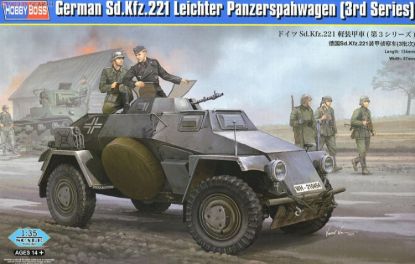
The Leichter Panzerspähwagen (Sd.Kfz. 221) was the first in a series of light reconnaissance vehicles designed to meet operational requirements including reliability, an ability to run on a variety of grades of fuel, simple construction and good off-road performance.
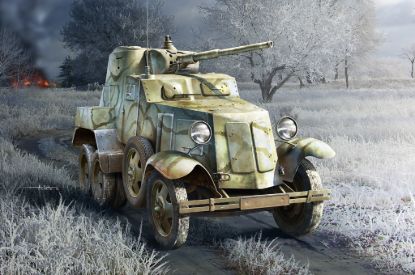
The BA-10 (Russian: Broneavtomobil 10) was an armored car developed in the Soviet Union in 1938 and produced through 1941. It was the most produced Soviet pre-1941 heavy armored car – 3311 were built in three versions. These versions were the BA-10, the BA-10M (improved version with new radio), and the BA-10ZhD (equipped for dual railway/road use).