Products tagged with 'Canada'
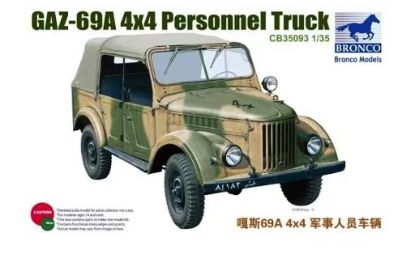
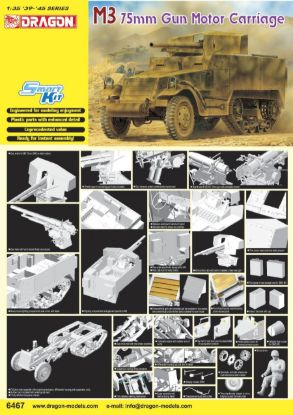
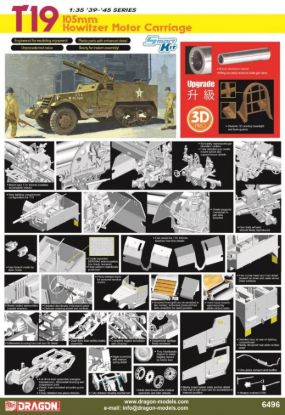
T19 105mm HOWITZER MOTOR CARRIAGE (SMART KIT)
Dragon Models 6496
T19/M21 81 mm MMC – M3-based mortar motor carriage equipped with the M1 mortar (81 mm) (97 rounds), designed to allow the mortar to be fired from within the vehicle.
$60.00
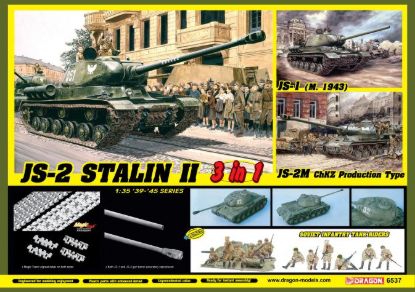
JS-2 STALIN II (3 IN 1) + SOVIET INFANTRY TANK RIDERS
Dragon Models 6537
The JS-1, also known as the IS-1, was a heavy tank developed by the Soviet Union during World War II. It was designed to counter the German Panther and Tiger I tanks and was primarily used as a breakthrough tank.
$60.00
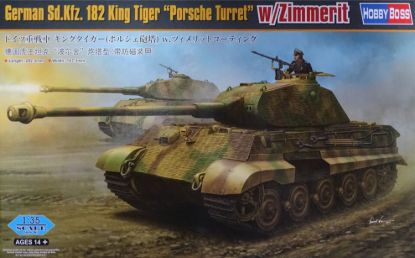
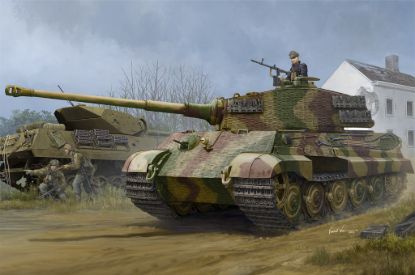
Germany Sd.Kfz.182 King Tiger Porsche turret w/zimmerit
Hobby Boss 84530
The Tiger II was the successor to the Tiger I, combining the latter's thick armour with the armour sloping used on the Panther medium tank. Contemporaneous Allied soldiers often called it the King Tiger or Royal Tiger. It was the costliest German tank to produce at the time. The tank weighed almost 70 tonnes and was protected by 100 to 185 mm (3.9 to 7.3 in) of armour to the front. It was armed with the long barrelled (71 calibres) 8.8 cm KwK 43 anti-tank cannon. The chassis was also the basis for the Jagdtiger turretless Jagdpanzer anti-tank vehicle.
$48.00
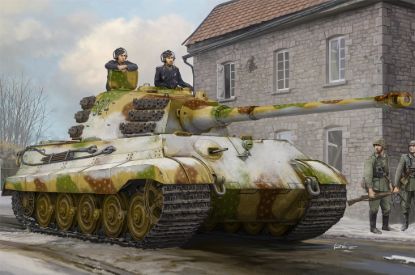
Pz.Kpfw.VI Sd.Kfz.182 Tiger II (Henschel 1944 Production) w/ Zimmerit
Hobby Boss 84531
The Tiger II was the successor to the Tiger I, combining the latter's thick armour with the armour sloping used on the Panther medium tank. Contemporaneous Allied soldiers often called it the King Tiger or Royal Tiger. It was the costliest German tank to produce at the time. The tank weighed almost 70 tonnes and was protected by 100 to 185 mm (3.9 to 7.3 in) of armour to the front. It was armed with the long barrelled (71 calibres) 8.8 cm KwK 43 anti-tank cannon. The chassis was also the basis for the Jagdtiger turretless Jagdpanzer anti-tank vehicle.
$48.00
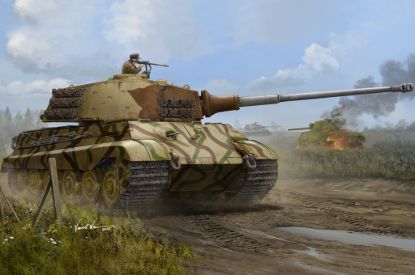
Pz.Kpfw.VI Sd.Kfz.182 Tiger II (Henschel Feb-1945 Production)
Hobby Boss 84532
The Tiger II was the successor to the Tiger I, combining the latter's thick armour with the armour sloping used on the Panther medium tank. Contemporaneous Allied soldiers often called it the King Tiger or Royal Tiger. It was the costliest German tank to produce at the time. The tank weighed almost 70 tonnes and was protected by 100 to 185 mm (3.9 to 7.3 in) of armour to the front. It was armed with the long barrelled (71 calibres) 8.8 cm KwK 43 anti-tank cannon. The chassis was also the basis for the Jagdtiger turretless Jagdpanzer anti-tank vehicle.
$48.00
Pz.Kpfw.VI Sd.Kfz.182 Tiger II ( Henschel July-1945 )
Hobby Boss 84533
The Tiger II was the successor to the Tiger I, combining the latter's thick armour with the armour sloping used on the Panther medium tank. Contemporaneous Allied soldiers often called it the King Tiger or Royal Tiger. It was the costliest German tank to produce at the time. The tank weighed almost 70 tonnes and was protected by 100 to 185 mm (3.9 to 7.3 in) of armour to the front. It was armed with the long barrelled (71 calibres) 8.8 cm KwK 43 anti-tank cannon. The chassis was also the basis for the Jagdtiger turretless Jagdpanzer anti-tank vehicle.
$45.00
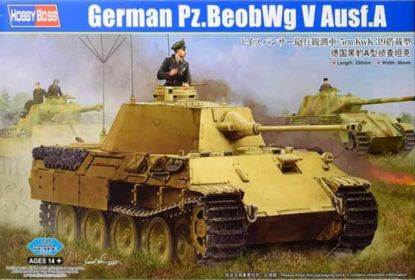
Germany Pz.BeobWg V Ausf.A
Hobby Boss 84534
The Pz.BeobWg V Ausf.A, also known as the Panther IV artillery observation tank, was developed as a successor to the Panther IV. It was based on the A-type hull and equipped with a swivel turret and a dummy barrel. By the end of the war, about 40 vehicles had been completed, and some were said to have been deployed in combat.
$60.00
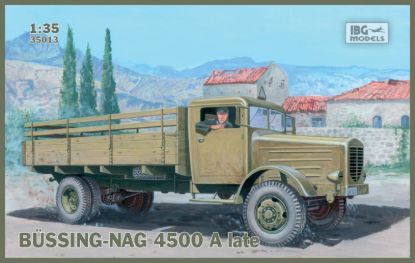
BUSSING-NAG 4500A
IBG 35013
The Bussing-NAG 4500 series was a significant part of the German military's heavy truck production during World War II. These trucks were known for their reliability and were used to transport fuel, ammunition, and troops across Europe's battlefields. The 4500 series was produced from 1941 to 1945, with nearly 15,000 units manufactured.
$36.00
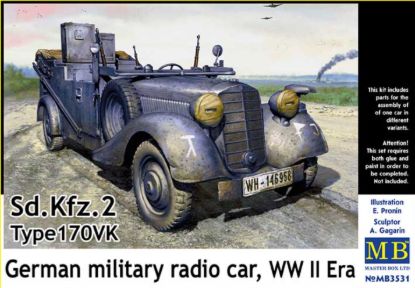
Sd.Kfz. 2 Type 170VK, Germany military radio car, WW II era
Master Box 3531
The Mercedes-Benz 170 VK exemplified the German Wehrmacht’s need for rugged, adaptable support vehicles during WWII. Its design balanced civilian comfort with military necessity, and its simplicity made it reliable in the field. Though not heavily armored or armed, some versions featured field adjustments or were used as staff cars. Though they were typically assigned to logistics units, signals detachments, and officer transportation roles.
$25.00